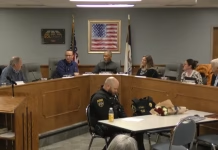


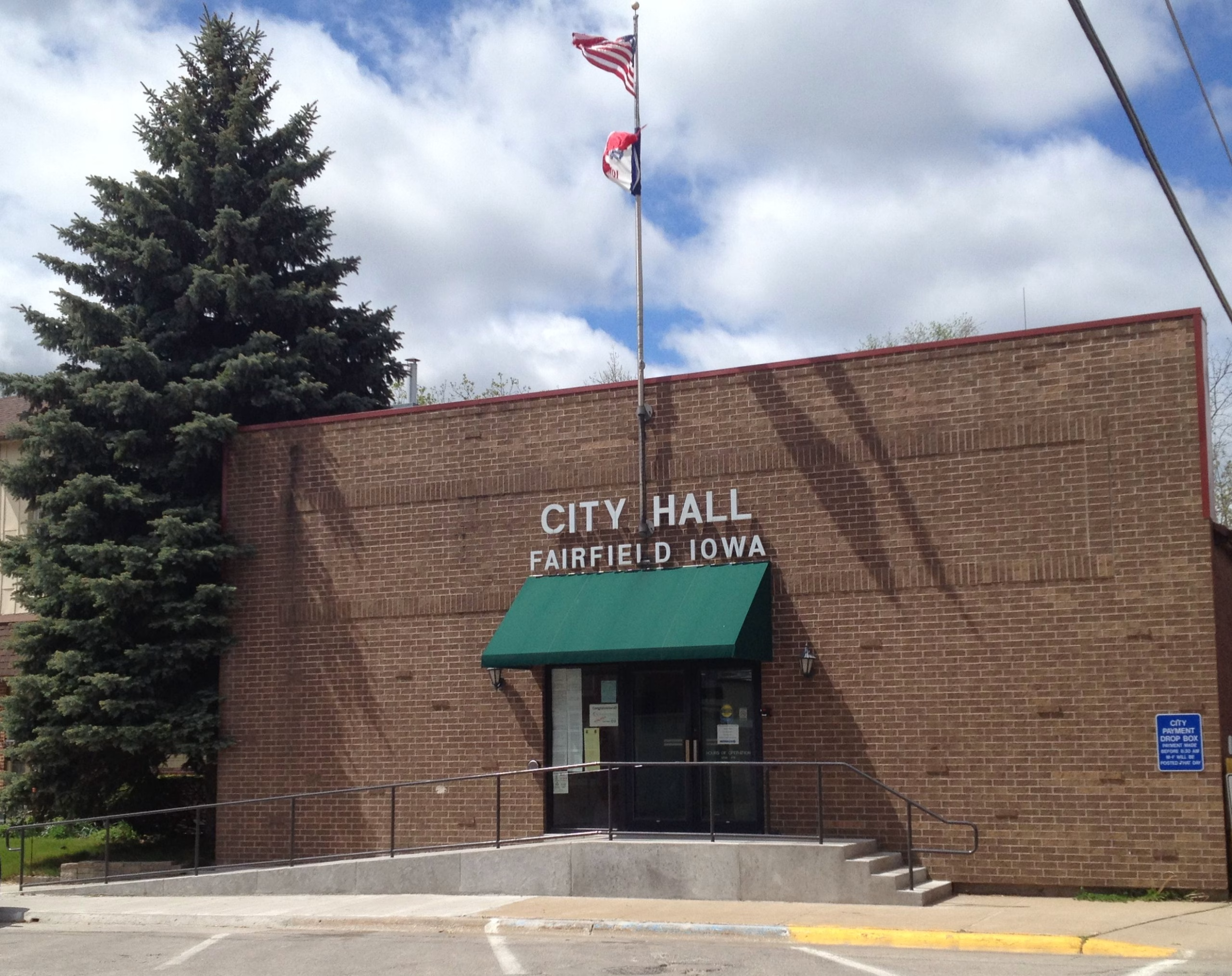
Fairfield City Attorney John Morrissey provided extensive commentary during Monday’s City Council meeting on two significant issues facing the community: HyCast Foundry’s air quality permit and potential state legislation regarding local law enforcement cooperation with Immigration and Customs Enforcement (ICE).
HyCast Foundry Environmental Concerns


Morrissey provided a detailed explanation of the city’s limited role regarding HyCast Foundry’s draft Title V Air Operating Permit from the Iowa Department of Natural Resources, while encouraging community participation in the regulatory process.
“Our city does not have anything in its ordinance or in the state code that allows us really to have much of a say about that,” Morrissey began. “Short of a public safety emergency or some kind of injunctive situation, which we’ve been fortunate in this town to not have to resort to those kinds of things. In this situation, both the state of Iowa and the federal government, DNR and EPA respectively, have jurisdiction over this.”
However, Morrissey emphasized that the city’s limited authority should not discourage residents from engaging in the process. “That doesn’t mean that people who are concerned about the potential for contaminants shouldn’t participate in this virtual hearing and give their input,” he said.
Drawing on local history, Morrissey referenced a previous environmental success story in Fairfield. “My two cents worth on that is that we had something like this many years ago with Malleable and Dexter Foundries, which resulted in a heightened awareness and some improvements on a catalytic stack over there that is still there today,” Morrissey explained. “There was a time when there was ash everywhere in southern Fairfield just from the way the wind blew, and the way the catalytic stack converter wasn’t really completely accomplishing what it was supposed to. So that got resolved with the agencies that monitor, but it also got resolved because there was community input.”
Morrissey strongly encouraged residents to participate in the upcoming regulatory proceedings. “I encourage people to maybe look back and consider at least listening in on that virtual hearing on the 29th,” he said, referring to the DNR’s virtual public hearing scheduled for Thursday, January 29th, from 7-9 p.m.
Immigration Enforcement and Due Process
Morrissey then transitioned to discussing potential state legislation regarding local law enforcement cooperation with Immigration and Customs Enforcement (ICE), an issue he has been monitoring closely over the past year.
“The second thing that’s going on, and I’ve talked to the council about every two months for a year, and I know that Chief Thomas was in on some of these conversations, is that there is something being sponsored in the Iowa legislature by one of our area legislators, Tyler Collins, that wants to mandate that every local law enforcement, if requested by ICE, must participate and assist,” Morrissey explained.
He outlined the position that had been established through discussions with the late Chief Dave Thomas. “My understanding in previous discussions with Chief Thomas was that if something like that came up, we would have a discussion whether the request was accompanied by due process, whether there was something that would be evident from either an administrative law judge—which are few and far between in this area—a warrant or order, or district court or magistrate Iowa district court warrant,” Morrissey said. “In those situations it would be an assurance that there would be a due process follow-up. So if there were some reason why ICE was going to apprehend somebody in our community, first of all we would be assured that it was the proper written authorization for that process, and secondly, we’d be assured that the individual that was being processed would have a due process hearing before there was any further activity. And I think that’s the understanding at the law center right now.”
Morrissey detailed a similar situation that played out in northern Iowa over the past year. “Essentially, what the problem with this is, is this already gone through the mill one time in the past year. The Attorney General and the governor were critical of two sheriffs up in northern Iowa, started in Decorah, and it started with ICE wanting to go after Luther College international students, and the sheriff up there took the position that only with due process assurances and appropriate warrants did he think the law enforcement in that whole county should participate in that request for assistance,” he explained. “That was in turn then adopted as the policy for the neighboring county.”
The conflict escalated when state officials threatened consequences. “They were trying to say that it was deviant law enforcement, that it was a sanctuary county or a sanctuary city, and that they would be denied state funds. That’s part of the present legislature all over again,” Morrissey said. “It spread over to Dubuque, which has three universities and a packing plant. The Dubuque law enforcement—combined police and sheriff—said we’re just not going to do it.”
However, the standoff eventually resolved in favor of reasonable protections. “About two months into this, as far as it being a standoff between the Attorney General’s office and the sheriffs, the Attorney General backed off on that position and said ‘alright, alright, you have some conditions.’ And the conditions are very reasonable conditions—due process, advance notice, and warrants that come from judges aren’t unreasonable,” Morrissey stated. “For the most part, in situations where there is review by the judicial branch, you’re also going to be assured that people aren’t flown to Louisiana overnight with no opportunity to be heard.”
Morrissey explained that this position has been thoroughly discussed with local law enforcement. “Our posture I think in this situation has been talked over repeatedly with Dave over time, and we never really had any of those issues,” he said. “The fact that we’ve got 89 nationalities in this community, we have every kind of visa status, and that we’ve got five immigration lawyers in the county says something about the potential for this being an issue, but I think that’s also something that’s being watched closely.”
He expressed confidence in Maharishi International University’s cooperation with local authorities. “I’m comfortable that the university is policing itself, and if there was something that should be in front of law enforcement, that they would cooperate fully. They’ve got their own security out there, but I don’t think for a minute we should ignore the fact that we’ve got full-scale opportunities for assistance from our law enforcement in the circumstances that justify it,” Morrissey said.
Looking ahead to potential legislative action, Morrissey outlined the city’s firm stance. “That being the case, I don’t know where the legislature is going to go with this coming forward, but I believe that we will be maintaining a position about due process, about prior notice, and about standards that relate to judicial warrants,” he stated. “Those are all things that are consistent with both our state constitution and our federal constitution. I don’t think we’ll have any trouble supporting our side of that argument.”
Morrissey clarified the city’s overall position on immigration enforcement. “As far as things that have to do with ICE, our city’s posture is not that we disagree that there should be immigration enforcement, or that we are not aware that we have an international population,” he said. “My belief is we’ve got about three dozen visa workers that are part of Ottumwa employment right now, and that we’ve got a variety of different kinds of visa work out on campus. Plus we have student visas, plus we have religious visas, plus we have highly-defined educator qualifications for visas, and all of those things have their place in the community like we are. We are a diverse community, and there isn’t any reason we shouldn’t be able to make that work.”
He noted that ICE interactions with the community have been minimal so far. “So far, my understanding is we’ve had probably a couple visits from ICE that weren’t really looking for enforcement assistance. They were looking into things that were paperwork, and other than that, there are some people in the community that are actively working on visa status and things like that,” Morrissey said. “I leave them in the hands of our private practitioner specialized immigration law attorneys, of which we have two or three of them on the campus, we have a couple of them off-campus, and that is where we’ll leave it.”
Posts were made on social media related to ICE activity in Fairfield around December 20th and 21st last year.
Morrissey concluded by emphasizing his availability and the collaborative approach among local officials. “But if we are called upon, I’m available on my cell phone 24 hours a day as far as what might come up at the law center as far as a request, and I have great confidence in our local supervisory law enforcement,” he said. “I’ve talked to the County Attorney about this, and I think we see eye-to-eye on this as a situation where the constitutional requisites are what our standard is.”