

An Iowa Senate subcommittee advanced a bill Wednesday banning materials and instruction related to gender identity and sexual orientation for Iowa 7th through 12th grade students as a similar ban on these subjects for K-6 students is being challenged in court.
Senate File 2003 proposes expanding a portion of Senate File 496, the 2023 Iowa law that bans programs, materials and instruction related to gender identity and sexual orientation for K-6 students. The bill applies to public school districts, charter schools and innovation zone schools. The 2023 law also prohibited books that contain depictions of sexual acts from being available in K-12 school libraries.
Several advocates spoke in support of the measure, saying that issues regarding gender and sexuality should only be discussed with parental consent and oversight. Anita Fischer with the group “Protect My Innocence” said expanding the measure is needed because older students are often the people questioning aspects of their identity like gender and sexuality.
“Especially as the parent of a junior in high school, I hear firsthand about the social contagion of confused sexuality among teens just entering high school,” Fischer said. “What we are seeing, of particular interest, is that it’s freshmen, ages 13 to 15, who are struggling the most. It is worth noting that these are students who are exposed to the very content this bill seeks to address … before legislation had passed (restricting gender and sexuality instruction and materials) for kindergarten through sixth grade.”
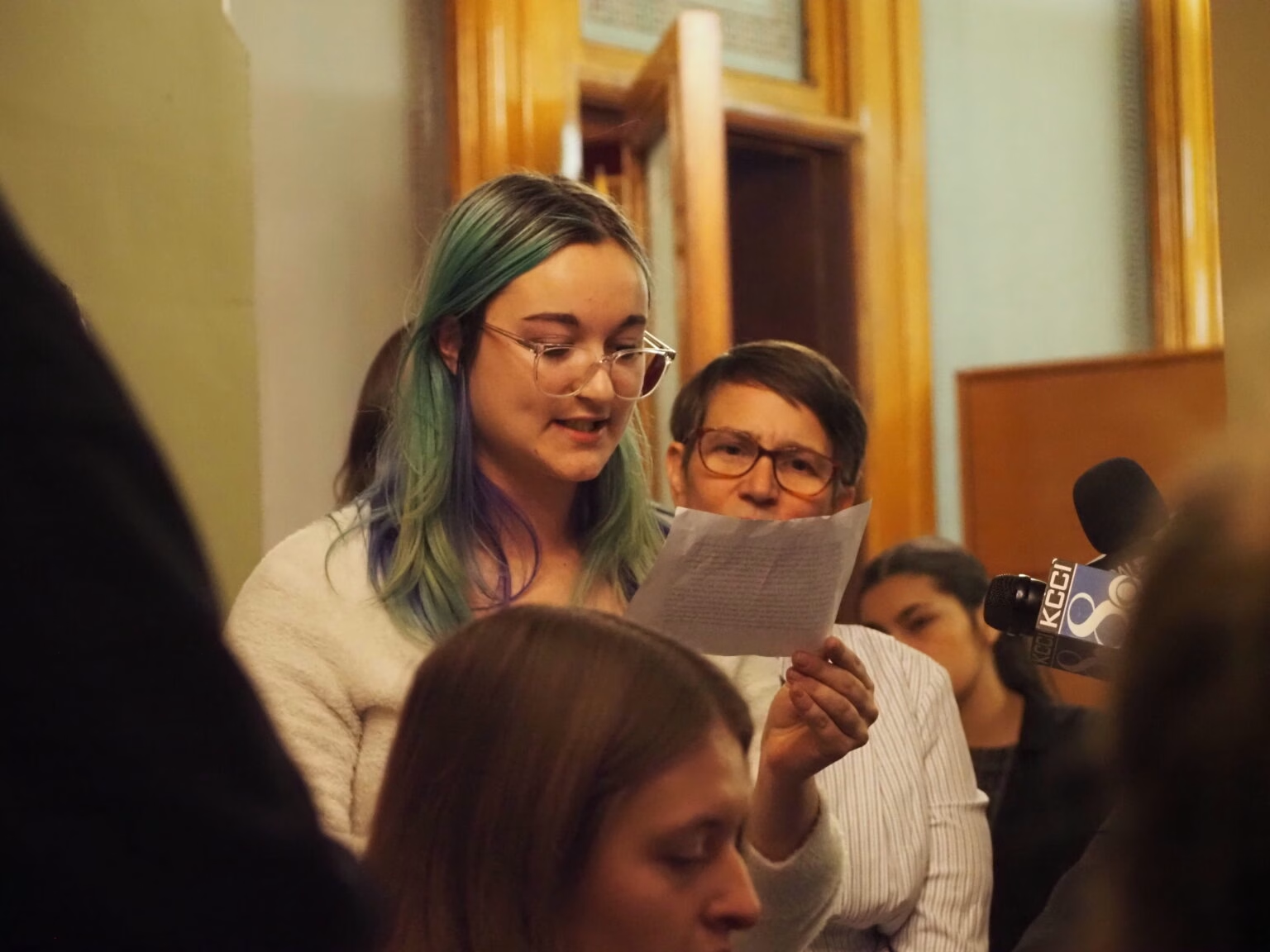
Bethany Snyder and her daughter Evelynn Snyder Maul spoke in opposition to the bill, saying it would prevent Evenlynn, a freshman at Valley High School in West Des Moines, from speaking at school about her parents, a queer woman and transgender man.
Snyder told lawmakers silence on LGBTQ subjects in schools does not protect children, but isolates them.
“High school should prepare students for the real world,” Snyder said. “In the real world, LGBTQ people exist, as parents, co-workers, legislators, historical figures and leaders, and families like mine and families like hers. … Our family exists, and no law will change that. You get to decide whether Iowa schools respond to students with honesty and care, or fear and silence. But either way, our family will continue to exist.”
There are multiple lawsuits challenging the 2023 law. One filed by the publisher Penguin Random House and several authors, including Jodi Picoult, John Green and Laurie Halse Anderson alongside the Iowa State Education Association, focuses on the provisions banning certain books from school libraries. Another lawsuit, filed by the American Civil Liberties Union and Lambda Legal, challenges the provisions of the law restricting access to books as well as class materials related to gender and sexuality.
The ACLU and Lambda Legal case argues Iowa students’ First and 14th Amendment rights to free speech, free association, equal protection and due process are violated by the law, and that these provisions lead to higher safety risks and discrimination against LGBTQ students.
There is currently an injunction in place on parts of the 2023 law, granted by a federal district court in May 2025. Several advocates told lawmakers the ongoing litigation shows there are major constitutional questions about the restrictions on younger students — and that the restrictions would face even more risk of running afoul of constitutional rights if applied to older students.
Damian Thompson with Iowa Safe Schools said older students have “stronger, well-established constitutional rights” that would be violated if this bill became law.
“High school students can vote soon, they can serve in the military, and they’re expected to understand complex social and health issues as they enter adulthood,” Thompson said. “Federal courts have been consistently clear that students do not shed their First Amendment rights when they enter a public school. As students get older, the state’s authority to broadly restrict access to information becomes more limited, not more expansive.”
Thompson said the proposal would also add new difficulties for schools working to meet curriculum requirements — specifically in regard to requirements on teaching human growth and development.
“Every person has a sexual orientation and a gender identity, whether or not we acknowledge it,” Thompson said. “Iowa law requires instruction in human growth and development, including instruction regarding human sexuality, in grades seven through 12. We cannot meaningfully teach the subject while pretending that these two things don’t exist.”
Danny Carroll with the Family Leader said issues regarding gender have become a “distraction” in public schools.
“Iowans have grown a little bit weary of the distraction — and sometimes very loud and profane distraction — that gender theory has brought on,” Carroll said. “And I think they’re inclined to think, perhaps, we should return our school to some of the fundamentals of learning and put this aside. I can see no way that this would interfere with teaching goodwill, friendship, respect for each other that has always been a part of our public school experience.”
The measure advanced out of subcommittee with Sens. Jesse Green, R-Boone, and Sandy Salmon, R-Janesville, supporting the measure. Democratic Sen. Molly Donahue did not support the measure.
Donahue said she agreed with Carroll calling this issue a “distraction.”
“Iowans are definitely tired of this type of legislation, and we’re seeing that with the voting records, not just in Iowa but across the United States,” Donahue said. “We should be focused on prioritizing public schools, funding, affordability for our people in this state, and making sure that we’re balancing a budget in this state that is currently over $1 billion dollars in deficit.”
Salmon said she supports the measure because there are reasons why a family may not want their children to learn about issues regarding gender and sexuality in K-12 schools.
“Just as not all parents want others to teach their children about sex education, because it involves family religious beliefs about sexuality, so (do) not all parents want others to teach children about sexual orientation and gender identity, because it too involves family religious beliefs about sexuality and sexual ethics,” Salmon said.
The measure moves to the Senate Education Committee for further consideration.