


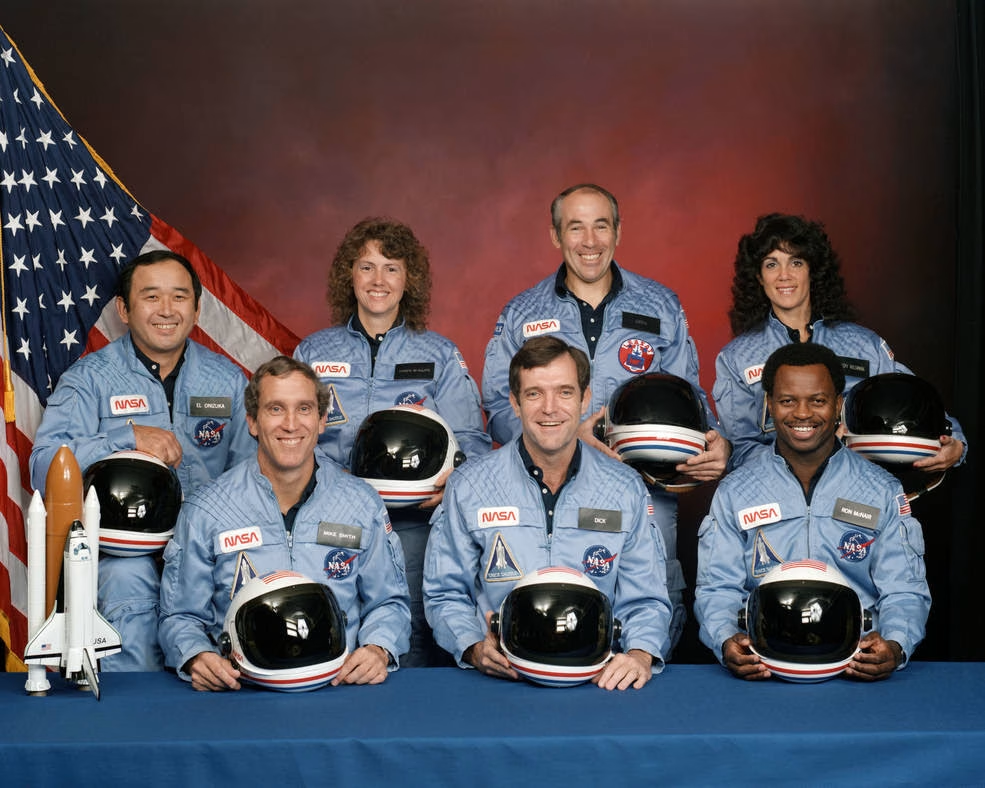
On the morning of January 28, 1986, the United States watched in shock as the Space Shuttle Challenger broke apart just 72 seconds after liftoff, killing all seven astronauts aboard. What was meant to be a moment of national pride quickly became one of the darkest days in the history of NASA and American space exploration.
The launch took place at 11:38 a.m. Eastern Time from Kennedy Space Center in Florida. Millions of Americans were watching live, many of them schoolchildren, because the mission included Christa McAuliffe, a New Hampshire high school teacher selected as the first participant in NASA’s Teacher in Space Project. Her presence symbolized a bridge between space exploration and everyday Americans, making the mission especially significant—and the loss especially painful.
As Challenger climbed through a clear but unusually cold Florida sky, a catastrophic failure occurred in the shuttle’s right solid rocket booster. Rubber O-ring seals, designed to prevent hot gases from escaping, failed due to the cold temperatures. Superheated gases burned through the booster, ruptured the external fuel tank, and caused the shuttle to disintegrate mid-air. The explosion was not an immediate fireball from the orbiter itself, but rather a violent structural breakup caused by aerodynamic forces and fuel ignition.
The crew members lost were Commander Francis “Dick” Scobee, Pilot Michael Smith, Mission Specialists Ronald McNair, Ellison Onizuka, and Judith Resnik, Payload Specialist Gregory Jarvis, and Teacher in Space Christa McAuliffe. Their deaths stunned the nation. Schools across the country turned off televisions and sent students home early. Flags were lowered to half-staff. President Ronald Reagan postponed the State of the Union address and later addressed the nation, reassuring Americans that “the future doesn’t belong to the fainthearted.”
In the weeks that followed, a presidential commission—later known as the Rogers Commission—was formed to investigate the disaster. Its findings revealed not only the technical failure of the O-rings, but deeper organizational issues within NASA. Engineers had warned that launching in such cold conditions posed serious risks, yet those concerns were overridden by schedule pressure and flawed decision-making. The report exposed communication breakdowns between engineers and management and highlighted a culture that underestimated danger after years of seemingly routine shuttle flights.
The Challenger disaster grounded the Space Shuttle program for nearly three years. NASA redesigned the solid rocket boosters, reworked safety protocols, and reassessed how risk was evaluated and communicated. The tragedy fundamentally changed how space missions were planned and approved.
Beyond engineering and policy changes, the disaster left a lasting emotional legacy. Christa McAuliffe’s goal of inspiring students lived on through the Challenger Center for Space Science Education, established in her honor and that of her fellow crew members. Their names remain etched into memorials, textbooks, and the collective memory of a nation reminded that exploration comes with real and sometimes devastating risks.
Forty years later, the Challenger disaster is remembered not only for what went wrong, but for the lives lost in the pursuit of knowledge and discovery—and for the hard lessons that reshaped America’s approach to spaceflight forever.